Classes 1–3 · Ages 6–9
Lower elementary studio
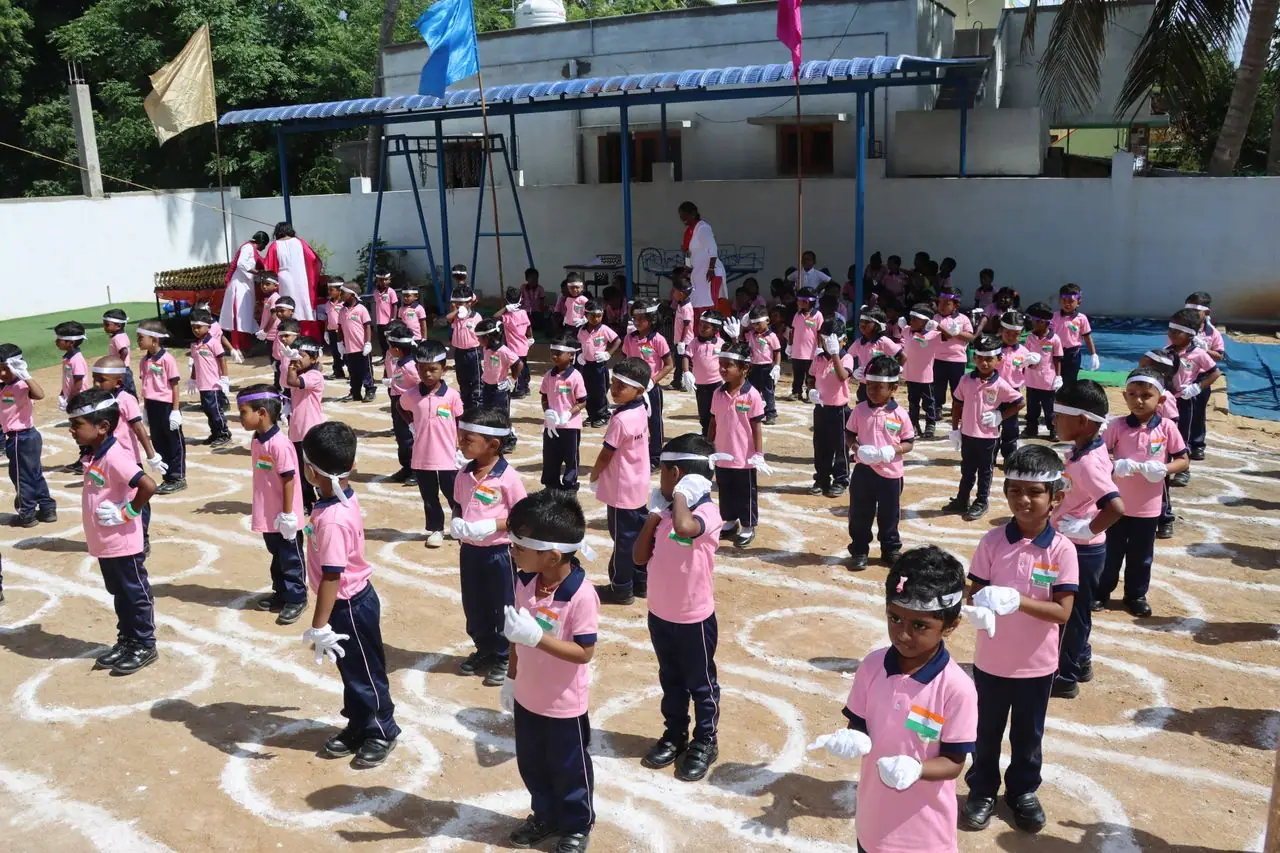
Transitioning from concrete sensorial foundations into abstract thinking, collaborative exploration and cosmic inquiry. The work is still handled before it is written down.
Academics
Rather than isolating subjects into rigid 45-minute silos, elementary learning is held together by Maria Montessori's Cosmic Education — five stories that give children a grand panorama of the universe, and then let them find their place in it.
01 — The studios
Children stay with the same guide and the same room across a multi-year cycle. That continuity is the curriculum's spine.
Classes 1–3 · Ages 6–9
Transitioning from concrete sensorial foundations into abstract thinking, collaborative exploration and cosmic inquiry. The work is still handled before it is written down.
Classes 4–5 · Ages 9–11
Advanced conceptual analysis, independent research projects, higher mathematics, literary composition and community leadership — including organising their own "going out" visits.
Mixed age
Because a nine-year-old can explain long multiplication to a six-year-old in a way no adult can, teaching becomes part of learning, and competition loses its grip.
02 — Cosmic education
Each lesson is a story and a demonstration, not a unit of study. Every subsequent project can be traced back to one of them.
Lesson 01
Astronomy, geology, chemistry and physics — the story of matter, stars and the planet underfoot.
Lesson 02
Botany, zoology, prehistoric life, evolution and ecology — how life arrived, diversified and adapted.
Lesson 03
Anthropology, early civilisations, culture and human invention — how people met their needs.
Lesson 04
Linguistics, grammar, creative writing and literature — how memory moved outside the body.
Lesson 05
The history of mathematics, arithmetic, geometry, algebra and real-world computation.
The result
A fraction is not a worksheet topic. It is one of the ways human beings learned to describe the world.
03 — Subject integration
Montessori materials are self-correcting: the child sees the error in the material, not in an adult's face.
| Domain | Focus | Materials & practice |
|---|---|---|
| Language & literacy | Phonetic mastery, grammar, syntax, etymology and public speaking. | Grammar boxes, sentence analysis charts, etymology cards, word study, literature circles. |
| Mathematics & geometry | Concrete arithmetic progressing to abstract calculation; plane and solid geometry. | Golden beads, stamp game, checkerboard multiplication, test-tube division, fraction insets, geometric cabinet. |
| Sciences | Classification of living organisms, plant anatomy, ecosystems and human physiology. | Living classification charts, botany nomenclature cards, microscope studies, school-garden botany. |
| Geography & history | Physical geography, cultural anthropology, timelines of civilisations. | Puzzle maps, land and water forms, pin maps, economic geography charts, timelines of life and humans. |
| Arts, music & practical life | Self-expression, motor coordination, auditory training and culinary skill. | Colour theory, clay sculpting, Orff percussion, Montessori bells, yoga asanas and culinary workshops. |
04 — The triad of learning
The prepared environment
Orderly, beautiful and self-sufficient, with an intentional progression from concrete manipulation to abstract deduction.
The child's self-regulation
Students schedule individual assignments, small-group lessons and collaborative investigations, under guide oversight.
The Montessori guide
The guide circulates, watches unobtrusively, and gives tailored three-period lessons to individuals and small circles.
05 — Assessment
We discard high-anxiety ranking and competitive testing in favour of continuous qualitative assessment. That does not mean nothing is measured — it means the record is richer and belongs to the child.
“The hands are the instruments of the intelligence.”
Maria Montessori
Next
Five steps, no entrance exam, and a classroom observation for parents before any offer is made.